

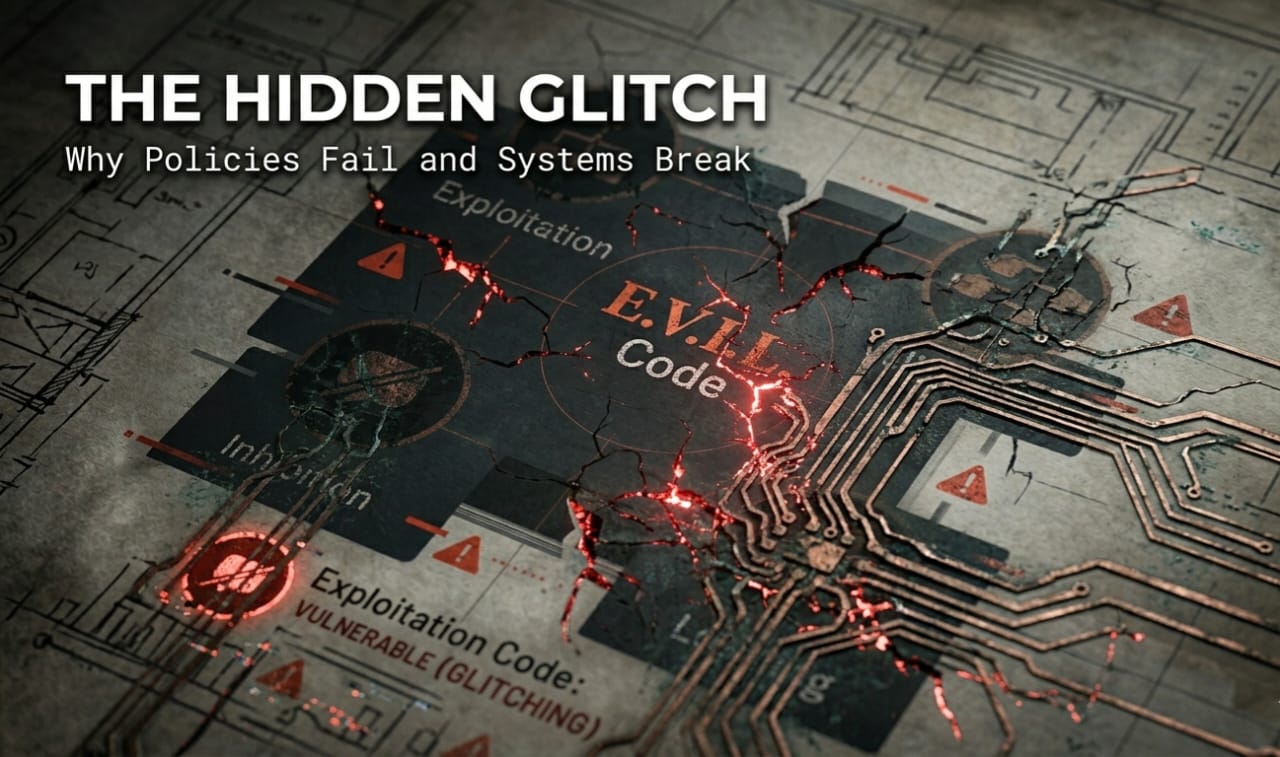
L.I.V.E. Philosophy, Leadership & Organizational Culture
The Hidden Glitch in Your Corporate Code: Why Policies Fail and Systems Break
By Ola Akinwe Institutional Safeguarding & Behavioral Risk Consultant
Executive Insight
The Problem
Organizations rely on policies and leadership training to prevent failure—yet cultural breakdowns and ethical breaches persist.
The Cause
Most failures are not driven by individuals, but by unaddressed vulnerabilities in the organizational system—misaligned incentives, suppressed feedback, and unchecked power structures.
The Solution
Shift from compliance to system design by identifying and eliminating behavioral risks embedded in the organization’s operating structure.
When Compliance Fails
In complex systems, failure is rarely sudden. In aviation, disasters are seldom caused by a single catastrophic error; rather, they result from a chain of small, unaddressed breakdowns that accumulate over time—until the system can no longer absorb the strain. The same dynamic applies within organizations. When the Wells Fargo scandal surfaced, it was not the result of isolated misconduct, but the predictable outcome of misaligned incentives, sustained performance pressures, and reinforcing cultural signals. What failed was not policy. What failed was the system itself.
“Failures are rarely random.
They are the result of small, unaddressed system flaws compounding over time.”
Hidden flaws in systems often remain undetected until they trigger major breakdowns, turning what appears minor into costly organizational failure.
A System, Not a People Problem
Organizations do not fail because of bad actors; they fail because their systems allow predictable risks to persist. What appears as isolated misconduct is the visible outcome of invisible structural weaknesses—patterns embedded in incentives, workflows, and power dynamics. This is your Human Operating System: the unwritten logic that governs how people interact and what behaviors are rewarded or suppressed.
Organizations don’t fail because of people.
They fail because their systems allow failure to persist.
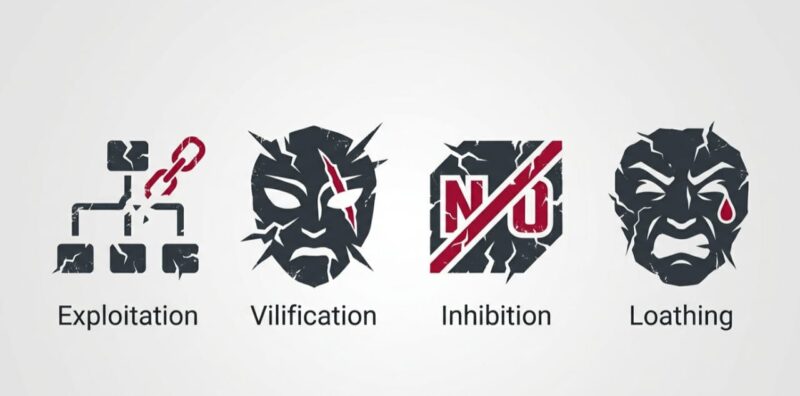
Behavioral Risk Is Structural: The E.V.I.L. Code
Most organizations are optimized for performance metrics, not for detecting the precursors of behavioral failure. Through years of research, I have identified four recurring vulnerabilities that form the E.V.I.L. Code. These are not cultural anomalies; they are systemic design flaws.
A signed policy cannot override a flawed system.
| Vulnerability | Mechanism | Manifestation |
| Exploitation | Power asymmetries operate without sufficient accountability. | Harassment protected by “high-performer” status; financial misconduct masked by revenue generation. |
| Vilification | Blame cultures suppress ownership and distort truth. | Whistleblower retaliation; cover-ups replacing transparent incident reporting. |
| Inhibition | Psychological barriers discourage reporting and transparency. | Bystander paralysis; “not my department” deflection of urgent ethical concerns. |
| Loathing | Negative emotional climates erode engagement and dignity. | Normalized cynicism; burnout treated as individual weakness rather than a systemic indicator. |
“Behavioral risk is not an HR issue.
It is a system design failure.”
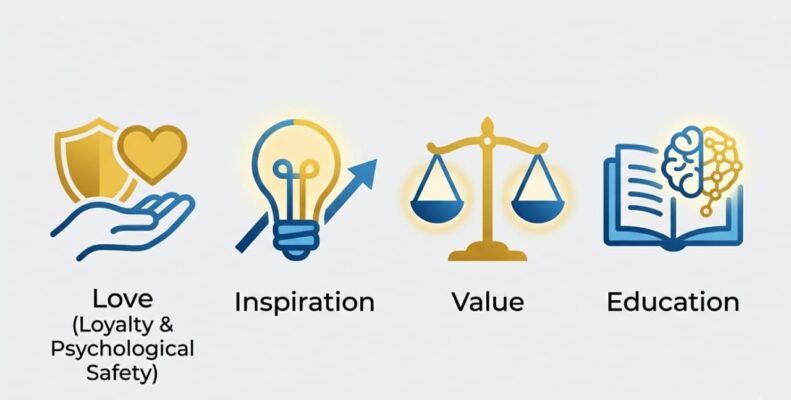
Compliance Is Not Enough: The L.I.V.E. Framework
What organizations require is a shift from managing behavior to engineering environments. This means moving safeguarding from an HR policy to an architectural standard. The L.I.V.E. Framework operationalizes this by embedding four foundational principles into your organizational design:
-
Love (Loyalty & Psychological Safety): Systems that enable openness and reporting without fear of retaliation.
-
Inspiration (Purpose Alignment): The structural linkage between individual roles and the organizational mission.
-
Value (Mutual Reinforcement): Incentive structures that align individual growth with institutional success.
-
Education (Continuous Capability): Ongoing development that strengthens behavioral awareness at every level.
A Diagnostic for Leaders
To assess your organization’s structural integrity, leadership must ask:
-
Do we have mechanisms to identify behavioral risk before it escalates?
-
Are employees incentivized to surface issues—or suppress them?
-
Is safeguarding embedded in daily operations, or is it confined to a PDF in the onboarding folder?
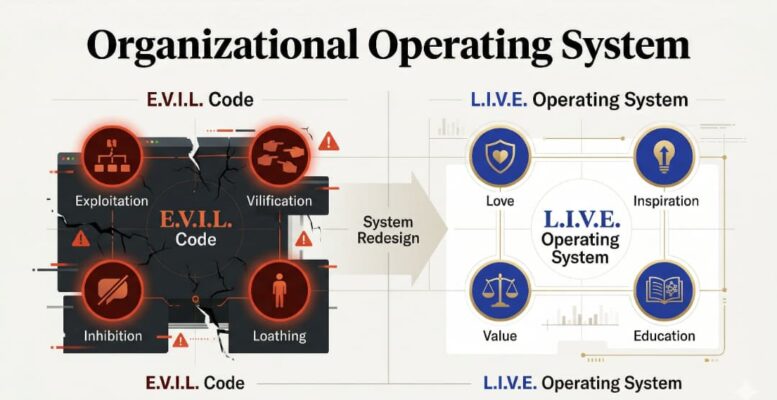
Audit the Code
The organizations that will lead in the coming decade are not those with the most policies, but those with the most resilient systems. The question for leaders is no longer: “Do we have the right policies?” The question is: “Is our system designed to prevent failure—or merely respond to it?”
“If your system is flawed, failure is not a possibility.
It is a probability.”
About the Author
Ola Akinwe is a Human Development Architect and Founder of LIVE Pathfinders Ltd and the Boys Mentoring Advocacy Network (BMAN). As an Institutional Safeguarding & Behavioral Risk Consultant officially licensed by the Lagos State Ministry of Youth and Social Development, he advises schools, corporations, and global institutions on mitigating human risk through systemic reformation.
Secure Your Institution’s Future
Is your organization running on a compromised code? Do not wait for a crisis to force your hand.
Request a Preliminary Structural Integrity Audit Our diagnostic tools identify the “glitches” in your Human Operating System before they become legal or reputational liabilities.
If you cannot map your organization’s behavioral risks, you cannot manage them.
The first step is not more training.
It is system diagnosis.
Begin with a Behavioral Risk Audit:
- Identify where E.V.I.L patterns exist
- Map decision flows and incentives
- Stress-test your safeguarding architecture
Because the cost of ignoring system flaws is not theoretical.
It is inevitable.
