Leadership & Organizational Culture
Your Leadership System is Obsolete: How to Patch the E.V.I.L. Corporate Virus
Editor’s Note
Even the most advanced workplaces can fail when leadership systems are outdated. In this essay, Ola Akinwe of LIVE Pathfinders Ltd reveals the E.V.I.L. corporate virus and offers a practical framework—L.I.V.E.—to transform culture, engagement, and long-term performance.
In 2019, a leading technology firm opened a $500 million headquarters featuring meditation pods, chef-curated dining, and nap rooms—an architectural symbol of the modern workplace. Two years later, their employee engagement scores had dropped twelve percent. The hardware was world-class. The operating system was failing.
This pattern repeats across industries. Organizations upgrade offices, implement sophisticated software, adopt powerful analytics, and build elaborate performance frameworks. By every measurable metric, the modern workplace is more technologically advanced than ever.
Yet engagement continues to decline. Burnout is normalized. Retention of top talent has become a persistent challenge, and terms like quiet quitting have entered the global business vocabulary.
Executives ask a familiar question: Why are our people disengaged when we have invested so much in the workplace?
The answer is increasingly clear. The problem is rarely the hardware.
The problem is the operating system.
“Many organizations attempt to run twenty-first-century talent on leadership systems designed for a different era. The problem is rarely the hardware. The problem is the operating system.”
In the knowledge economy, where creativity, adaptability, and initiative drive competitive advantage, outdated architectures built on control, hierarchy, and transactional labor produce predictable failures.
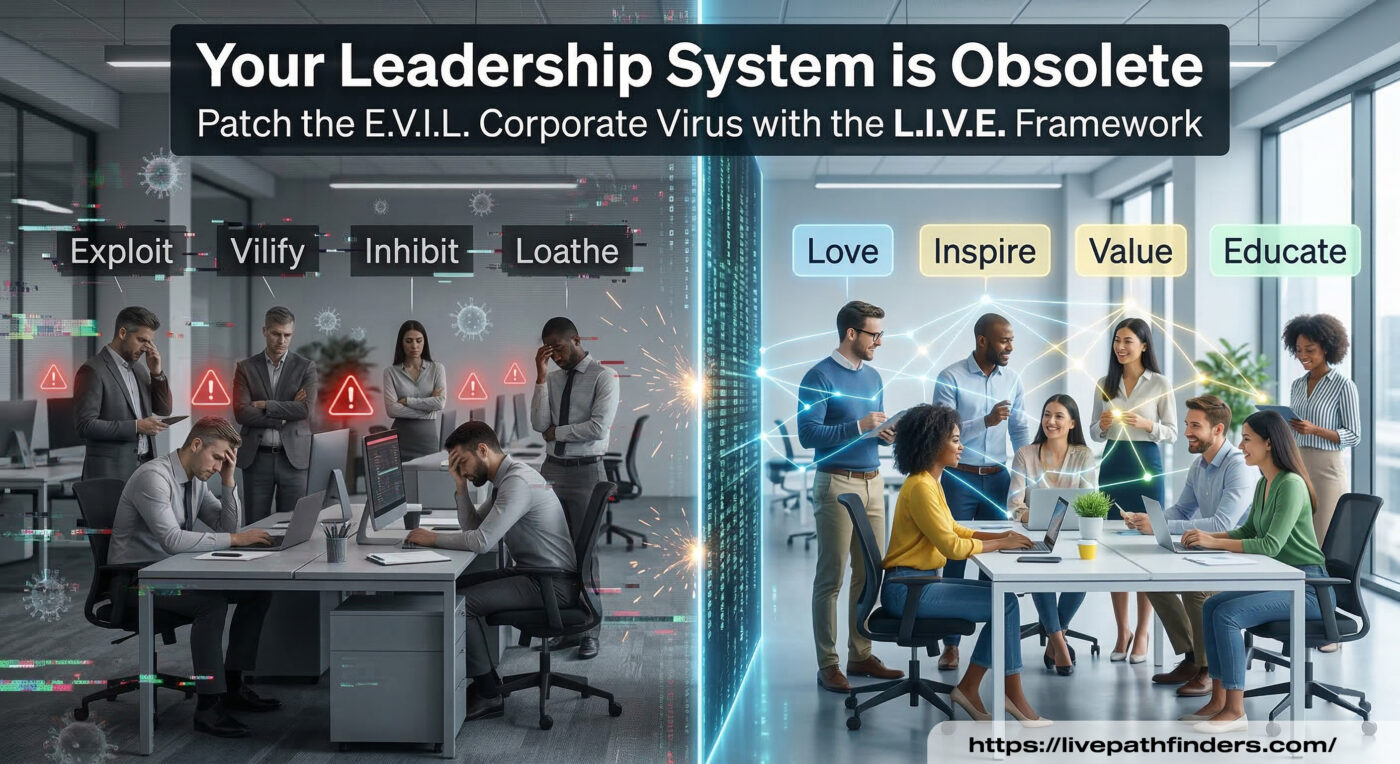
When organizations fail to upgrade their leadership operating system, cultural malware begins to spread. I describe this pattern as the E.V.I.L. organizational virus.
The E.V.I.L. Pattern in Organizational Leadership
Toxic cultures rarely emerge from single events. They evolve through repeated leadership behaviors that reshape internal logic. Four patterns appear consistently.
Exploit
The first sign is an exploitative productivity model. Employees become output-generating units rather than long-term assets. Leaders push short-term performance without equivalent investment in development, wellbeing, or sustainability.
“What seems like a talent shortage is simply the predictable outcome of an exploitative system.”
Initially, results appear strong. Over time, the environment breeds exhaustion, disengagement, and attrition.
Vilify
The second indicator is blame-based management. When mistakes occur, the system seeks individuals to punish rather than processes to improve. Employees learn that admitting problems carries reputational risk. Transparency declines. Communication becomes defensive. Innovation slows.
Research consistently shows that psychological safety—the ability to speak openly without fear of humiliation—is essential for innovation. Blame cultures destroy that safety.
Inhibit
The third element is inhibitive leadership, most commonly expressed through micromanagement. Leaders who cannot delegate create bottlenecks that slow decision-making and frustrate high performers. Instead of multiplying talent, they suppress it.
Capable professionals, feeling constrained by excessive control, disengage or seek environments where their capabilities can expand.
Loathe
The final outcome is cultural resentment. Employees who feel exploited, blamed, and constrained lose emotional connection to the organization. They perform minimum required work while mentally preparing for exit.
From the executive perspective, this looks like declining engagement and unexpected turnover. From the employee perspective, the environment simply no longer feels worth investing in.
Why Surface-Level Solutions Fail
Organizations often repair these problems with symbolic initiatives: wellness programs, occasional recognition events, workplace perks. These efforts may temporarily improve morale, but they rarely address underlying issues.
“Culture is not defined by occasional gestures like wellness programs or perks. It is defined by daily leadership behaviors and structural incentives.”
Repairing broken culture requires more than morale initiatives. It requires a shift in the leadership operating system itself.
Installing a New Leadership Architecture: The L.I.V.E. Framework
Organizations that consistently attract, develop, and retain exceptional talent operate on a different model—one designed around human capability rather than purely transactional performance.
“L.I.V.E. is not another leadership style. It is a leadership operating system designed to replace outdated cultural architectures that produce the E.V.I.L. organizational pattern.”
The L.I.V.E. Operating System, developed through L.I.V.E. Pathfinders Ltd, reframes leadership as the design of healthy human performance ecosystems.
The framework centers on four structural principles:
Love: Psychological Safety and Human Awareness
In professional contexts, love is best understood as structural respect and empathy. Google’s Project Aristotle research and Amy Edmondson’s work on psychological safety demonstrate that teams perform better when members feel safe to express ideas, challenge assumptions, and acknowledge mistakes. This trust allows organizations to surface problems earlier, experiment more freely, and collaborate more effectively.
Installation: Establish weekly “failure forums” where teams discuss mistakes without consequence; enforce explicit norms that protect minority viewpoints in decision-making.
Inspire: Connecting Work to Purpose
Traditional management focuses on task completion. Effective leadership connects daily activities to a broader organizational mission. When employees understand how their contributions influence larger systems, routine tasks become meaningful components of shared objectives. Purpose-driven alignment transforms compliance into commitment.
Installation: Ensure every all-hands meeting includes one stakeholder story demonstrating concrete impact; host quarterly “line-of-sight” sessions connecting individual roles to organizational outcomes.
“The most successful organizations view leadership not simply as authority, but as system design.”
Value: Creating Reciprocal Growth
Healthy organizations recognize that value must flow in both directions. Employees provide talent, time, and creativity. Organizations must respond with opportunities for learning, career progression, mentorship, and recognition. When employees believe their growth intertwines with organizational growth, engagement rises and retention strengthens naturally.
Installation: Make the development of direct reports an explicit promotion criterion; build internal mobility programs that reward cross-functional skill-building; design recognition systems that celebrate collaborative achievement over individual heroics.
Educate: Continuous Capability Development
In rapidly evolving industries, today’s relevant skills may lose relevance quickly. Organizations prioritizing continuous learning ensure workforces remain adaptable and competitive. Training programs, leadership development, and cross-functional exposure become mechanisms for preparing the organization for future challenges. Continuous education functions as a system-wide software update.
Installation: Protect time allocation for skill development; create rotation programs exposing high-potentials to different business functions; provide learning budgets tied to career progression rather than immediate job function.
Leadership as System Architecture
Leaders influence structures, incentives, and behaviors that determine how people interact. When systems encourage trust, growth, and purpose, performance follows. When they encourage fear, control, and short-term extraction, the organization destabilizes.
The distinction between thriving and struggling organizations often lies not in strategy, technology, or capital—but in the architecture of leadership itself.
The Strategic Cost of Cultural Neglect
“Companies failing to address these dynamics become developmental pipelines for competitors. They bear the costs of recruitment and training, while rivals capture the long-term value.”
Talented individuals join toxic environments, acquire valuable experience, encounter structural limitations, and depart for environments where capabilities can expand. The organization bears the costs of recruitment, training, and onboarding, while competitors capture the long-term value.
In an economy where talent mobility is high and knowledge capital drives innovation, this pattern is strategically unsustainable.
Patching the Corporate Operating System
Corporate culture is often described as intangible. In reality, it is the sum of leadership decisions repeated over time. When those decisions follow outdated assumptions, the system malfunctions.
When leaders intentionally redesign the operating system—prioritizing psychological safety, purpose alignment, reciprocal value, and continuous education—the organizational network strengthens.
In an era of constant change, thriving organizations will not simply upgrade their technology.
They will upgrade how their people experience work itself.
The organizations winning the next decade have already begun this upgrade. The only remaining question is whether your organization will lead the transition—or spend the next decade reacting to those who did.
About the Author & Firm
Ola Akinwe is a system architect specializing in leadership infrastructure redesign. Through L.I.V.E. Pathfinders Ltd, he helps organizations deploy the L.I.V.E. Operating System—transforming culture from transactional management to human-centered performance ecosystems.
Ready to run a Structural Leadership Audit? Contact info@livepathfinders.com
