L.I.V.E. Philosophy, Leadership & Organizational Culture
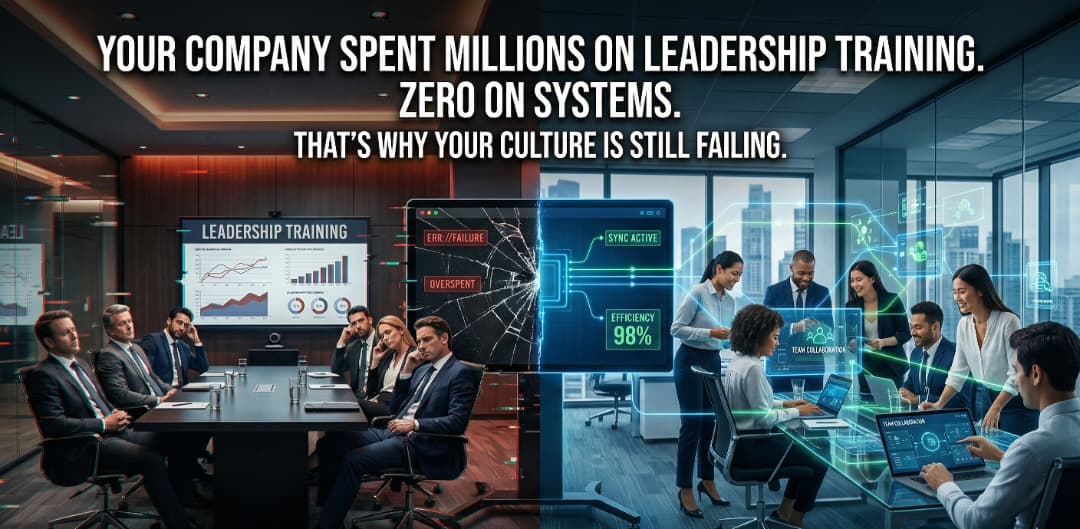
Your Company Spent Millions on Leadership Training. Zero on Systems. That’s Why Your Culture Is Still Failing.
Why the $350 billion leadership development industry is fixing the wrong problem.
By Ola Akinwe · Founder, L.I.V.E. Pathfinders Ltd.
In 2019, a Silicon Valley darling opened a $500 million headquarters with meditation pods, nap rooms, and chef-curated dining. Two years later, employee engagement had plummeted 12%. The hardware was world-class. The operating system was failing.
This isn’t an anomaly. It’s a warning.
Global organizations invest over $350 billion annually in leadership development, predominantly through individual coaching and behavioral training. Yet trust between employees and managers has collapsed from 46% to 29% between 2022 and 2024. Burnout is accelerating. Forty percent of leaders are contemplating departure.
We are treating leadership as a psychological trait to be taught to individuals, rather than as structural infrastructure to be engineered across the institution. When market pressure mounts, individual behavioral models collapse. Managers revert to factory-floor instincts, and a predictable pathology spreads.
I call it the E.V.I.L. pattern not as moral judgment, but as systemic failure: Exploitation of talent without sustainability investment; Vilification through blame-based management; Inhibition via micromanagement that bottlenecks decision-making; and the inevitable Loathing that produces quiet quitting and cultural resentment.
The problem isn’t that we’ve been teaching the wrong leadership models. Transformational, Servant, and Situational leadership are empirically sound. The problem is that we’ve been deploying them as behavioral suggestions for individuals rather than structural protocols for organizations.
| RESEARCH NOTE · Harvard Business School
Harvard Business School researchers documented this failure in “The Great Training Robbery”: billions spent on training that “fails to transfer into changes in individual and organization behavior.” When a manager develops exceptional empathy through coaching—but the organizational system rewards quarterly extraction—that empathy becomes a personal burden, not a professional asset. The system always wins. |
|
The Alternative: Treat Leadership as System Architecture
At L.I.V.E. Pathfinders, we’ve developed an operating system that hard-codes psychological safety and reciprocal growth into daily workflows—bypassing the volatility of individual charisma. The L.I.V.E. framework (Love, Inspire, Value, Educate) doesn’t ask managers to be heroes. It asks them to be architects.
Love translates servant leadership into quantifiable infrastructure: psychological safety as architectural guarantee. Google’s Project Aristotle demonstrated that psychological safety is the single most important factor for team effectiveness. Weekly “failure forums” protect minority viewpoints without consequence. Empathy becomes system property, not personal style.
Inspire extracts the benefits of transformational vision but removes reliance on charisma. Quarterly “line-of-sight” sessions structurally connect every employee’s KPIs to customer impact. Purpose becomes structural protocol, not oratory.
Value replaces transactional carrots and sticks with reciprocal workflows where employee output directly funds their own career growth—transitioning mercenaries to stakeholders through system design, not personality. The system itself creates the exchange relationship, institutionalising commitment without managerial theatrics.
Educate treats capability development as organisation-wide software updates rather than reactive interventions. Protected time for cross-functional skill building raises baseline readiness across the network, eliminating exhausting micromanagement and the need for constant situational adaptation.
The Competitive Advantage You Are Missing
Corporate culture isn’t an intangible feeling. It is the sum of leadership decisions repeated over time—the accumulated output of the organisation’s operating system.
The organisations that thrive in the coming decade will recognise a fundamental shift. They will upgrade not just their SaaS stacks, but how their people experience work itself. They will stop sending managers to isolated seminars to learn empathy and vision, and start synthesising the drivers of human performance into unified, accessible code that runs regardless of who occupies the managerial role.
The future of competitive advantage lies not in finding better leaders, but in engineering better systems—architectures that make good leadership the path of least resistance, and toxic patterns structurally impossible.
|
Ready to Move Beyond Leadership Training?
If your organization is still investing in leadership development without seeing meaningful cultural change, the issue may not be your people, it may be your system.
At L.I.V.E. Pathfinders Ltd, we help organizations design leadership operating systems that embed trust, alignment, and performance into everyday work.
What would change in your organization if leadership was built into the system and not left to individuals?
ABOUT THE AUTHOR
Ola Akinwe is Founder of L.I.V.E. Pathfinders Ltd., an organizational development firm specializing in behavioral system architecture. He works with institutions globally to deploy the L.I.V.E. Operating System.
