

L.I.V.E. Philosophy
The Universal Spiritual Language: Finding Meaning Beyond the Pews
Editor’s Note
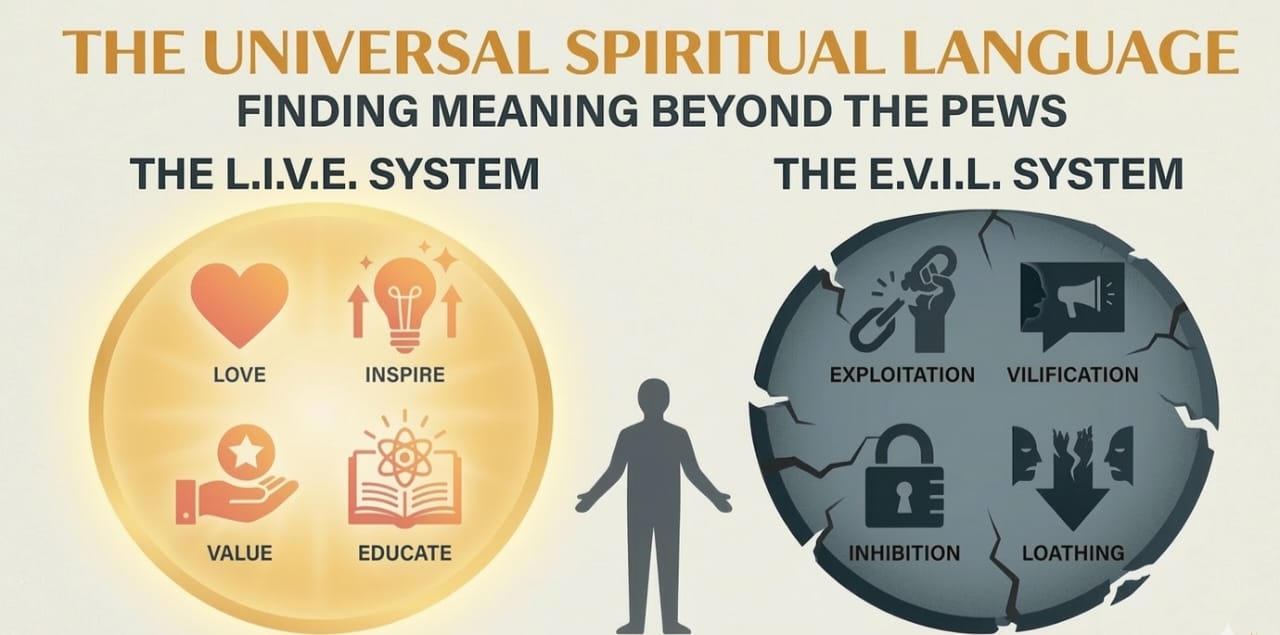
This essay introduces the philosophical foundation of the L.I.V.E. Operating System, developed by LIVE Pathfinders Limited. The framework proposes that human flourishing can be strengthened through four universal principles—Love, Inspire, Value, and Educate—and weakened through their opposites: Exploitation, Vilification, Inhibition, and Loathing. In a world increasingly divided by ideology, religion, and identity, the L.I.V.E. philosophy offers a universal language for building purposeful individuals and thriving societies.
For most of human history, spirituality has been inseparable from religion. Temples, mosques, and churches became humanity’s official gateways to meaning. Through rituals, doctrines, and promises of a divine afterlife, civilizations built intricate maps to guide us through the mystery of existence.
But what if those maps point to a destination that does not exist? What if the “Great Beyond” is simply a great silence—vast, unknowable, and empty of the celestial cities we have imagined for thousands of years? For many people, this thought produces a kind of existential vertigo. Civilization has long been built on two powerful assumptions: that morality requires a divine Judge and that purpose requires a divine Creator. Remove those pillars, and life can appear frighteningly unanchored.
Yet something remarkable is happening in our time, as more people quietly step away from rigid religious dogma a different realization is emerging—not one of despair, but of possibility. Spirituality, it turns out, may never have required religion in the first place.
If heaven is not waiting for us in the clouds, then the “spirit” is not a ghost trapped inside the human body. Instead, spirit is simply the name we give to our highest human capacities—our ability to love, uplift, recognize dignity, and pursue truth. To live spiritually is not to prepare for another world. It is to elevate this one.
 This realization opens the door to something new: a Universal Spiritual Language—a way of living that does not depend on theology, dogma, or blind faith, but on daily human practice. That language can be expressed through four simple yet profound principles: Love. Inspire. Value. Educate. Together they form the architecture of the L.I.V.E. philosophy.
Love: The Horizontal Sacrament
In traditional religious structures, love often flows vertically directed upward toward a deity or commanded downward as divine instruction. In a universal spiritual language, love moves horizontally. It is the recognition that every other human being is another version of ourselves—another consciousness navigating the same fragile existence. Without a divine observer keeping score, love becomes more urgent, not less.
You do not love your neighbor to earn points for a future paradise. You love them because, in a vast and often indifferent universe, we are all each other has. Every act of kindness becomes a quiet rebellion against chaos. Where the universe offers indifference, human beings can create warmth.
Love, in this sense, becomes humanity’s most powerful act of resistance.
Inspire: Becoming Living Scripture
The word inspire means “to breathe into.” Religion often looks to ancient prophets for that breath. But inspiration is not confined to the past. It happens whenever a human being demonstrates courage, resilience, or compassion in the face of difficulty.
When someone rises above suffering. When a leader sacrifices comfort for the collective good. When integrity triumphs over convenience. These moments are not merely admirable—they are spiritual. They remind us that humanity is capable of extraordinary goodness without fear of punishment or promise of reward.
In this sense, each of us carries a quiet responsibility: to become living scripture. Our lives become the stories that inspire others to believe in the possibility of human goodness.
Value: The Practical Soul
Religious traditions often ground human worth in the idea of the soul, a sacred spark granted by God. A universal philosophy translates that same insight into a more practical, radical principle: Value.
To value a person is to recognize their dignity not as a divine gift or a social utility, but as an intrinsic feature of being human. Value issues a definitive declaration: “You have worth simply because you exist.” It is the refusal to treat a human being as a transaction or a tool.
This shift transforms spirituality into a liberation movement. When we restore someone’s belief in their own worth, we are not merely being kind; we are performing the sacred act of returning their humanity to them.
Educate: The Sacred Search
Dogma offers final answers. Education offers evolution. Many belief systems claim possession of the “final truth.” The universal spiritual language embraces something different: curiosity.
To educate and to remain educable is an act of humility. It recognizes that the universe is larger than our current understanding. Learning becomes a lifelong spiritual practice.
When we teach others how to think, lead, and grow, we are not merely transferring knowledge. We are expanding human freedom. Education does not end the search for meaning, it keeps the search alive.
The L.I.V.E. Principle
Across cultures, eras, and belief systems, human societies appear complex and unpredictable. Yet beneath that complexity lies a simple pattern. Civilizations flourish when certain human forces are strengthened and decline when those forces are weakened.
This observation can be expressed as a simple principle: Human flourishing expands wherever Love, Inspiration, Value, and Education increase. Human suffering expands wherever Exploitation, Vilification, Inhibition, and Loathing take their place. This is the L.I.V.E. Principle.
It is not a religious doctrine or a political ideology. It is an observable pattern of human behavior. Where people are loved rather than exploited, communities thrive. Where individuals inspire rather than vilify, societies build rather than fracture. Where human dignity is valued rather than suppressed, potential unfolds. And where education expands rather than stagnates, freedom grows.
The health of a civilization can therefore be measured by a single question: Are its systems encouraging people to L.I.V.E. or quietly teaching them to practice E.V.I.L.?
The Shadow Language: E.V.I.L.
Every philosophy of human flourishing must also recognize the forces that undermine it. Where L.I.V.E. builds, its inverse destroys.
Instead of Love, societies fall into Exploitation—using others as tools rather than recognizing their humanity.
Instead of Inspiration, we see Vilification—the tearing down of individuals through cynicism, humiliation, and division.
Instead of Value, systems create Inhibition—the iron cage of human potential. Inhibition is the systemic denial of intrinsic worth. It is the force that whispers, “You are only what the system allows you to be; you are defined by your utility, your class, or your limitations.” While Value liberates the individual to reach upward, Inhibition creates artificial ceilings, trapping people in cycles of suppression and convincing them that their current cage is their only reality.
Instead of Education, cultures descend into Loathing—a hostility toward truth, curiosity, and growth.
These forces form the shadow language of the human spirit. E.V.I.L. is not supernatural. It is simply what happens when societies stop practicing L.I.V.E.
The New Heaven
If heaven is not waiting for us after death, we are not left with emptiness. We are left with responsibility. The L.I.V.E. philosophy suggests that salvation is not something granted in another world. It is something created in this one.
We find a form of immortality not through divine judgment, but through human impact—in the minds we awaken, in the hearts we comfort, and in the systems of dignity and opportunity we build for future generations.
Perhaps the greatest spiritual awakening of the twenty-first century will not come from new religions, but from a deeper understanding of what it means to be human. We do not need a golden city in the clouds to make life meaningful. What we need is the courage to speak a universal language—to Love without condition, to Inspire through action, to Value every human being, and to Educate for a brighter tomorrow.
A spirituality grounded in these principles does not merely promise a better world. It gives humanity the operating system to build one.
The future of humanity may depend on how well we learn to L.I.V.E.
The L.I.V.E. Principle
Human flourishing expands wherever Love, Inspiration, Value, and Education increase.
— Ola Akinwe
Creator, L.I.V.E. Operating System
Founder, LIVE Pathfinders Limited
An Operating System for a More Purposeful World
About the Author
Ola Akinwe is the architect of the L.I.V.E. Operating System, a philosophical and practical framework that reimagines spirituality as a human capacity expressed through Love, Inspiration, Value, and Education. He is the founder of LIVE Pathfinders Limited, an organization dedicated to building systems that help individuals and communities live with greater purpose and dignity.
